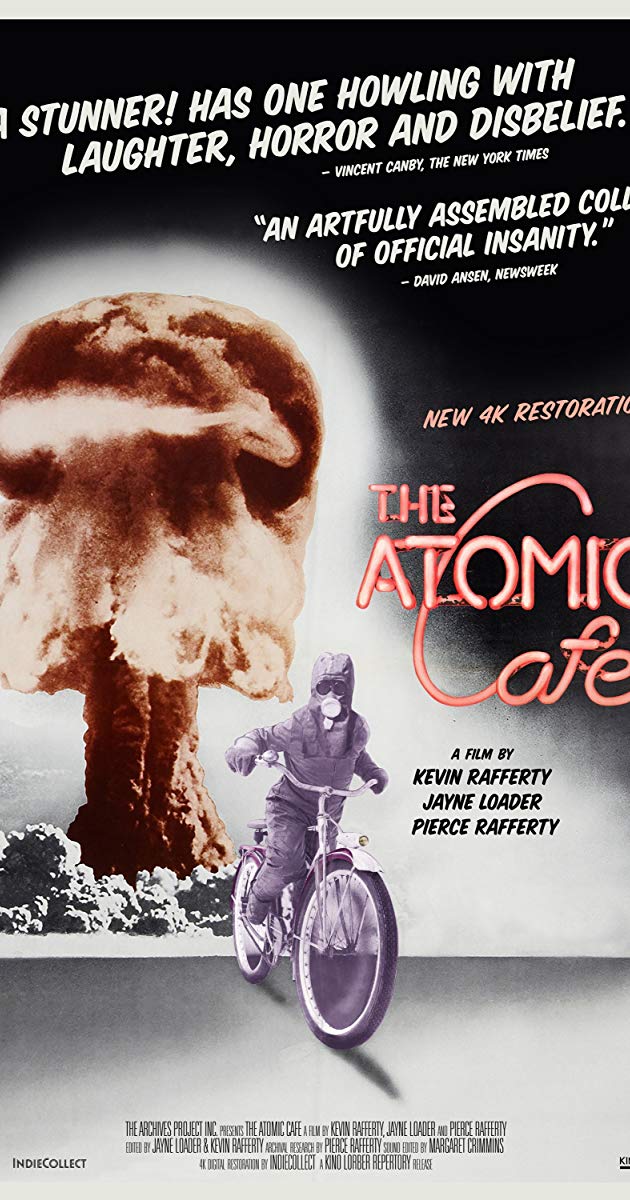
On the Beach, a Hollywood movie released in 1959 by producer Stanley Kramer based on the book published two years earlier by Nevil Shute, is about a world where the population is dealing with the aftermath of a nuclear war. The Atomic Café on the other hand is an American independent movie released in 1982 put together with footage of real events. Those two movies, one fictional and the other based on real events, are anti-nuclear proliferation. Their message is clearly to question the authorities, warn the public about the danger of nuclear weapons and their destructive capacities.
While one used romance and the other satire, they dealt with the political issue at stake in an attempt to push the public to educate itself on the matter.
On the Beach has all the elements of a Hollywood production, despite the dark tone of the movie there is also romance. The movie is about an atomic bomb that has exploded in the northern hemisphere and the population of the other side of the world is dying from the radiation emitted during the explosion. From the beginning it is clear that even if the victims have nothing to do with the use of the nuclear weapon they are dealing with the consequences.
The movie distracts us from time to time with characters that fall in love, a married couple tortured by their imminent death and their baby’s and a remorseful but cynical scientist. Despite the shadow of death above their heads there are only mentions of the tragic events happening and no scene of sickness or destruction is shown. The movie is somewhat sanitized and calls for our imagination while The Atomic Café is filled with shocking images. In the documentary not only can we see the harm that the bomb can do to the human body but we are also directly exposed to sickness and death. However, what is shown to us was hidden from the public back in the 1950’s after the Bikini island nuclear test. After making the inhabitants leave, the soldiers drop the bombs and the islanders even miles away suffered from radiation and marks on their bodies.
At the opposite of On the Beach the radiations are only affecting a limited area; their effect is only at the level of cities or islands. We can notice an element of Hollywood movies with this further exaggeration of the damages, not a country or island is erased but human kind as a whole. This alarming consequence might be for the audience to think that there is no safe place, and we must all be concerned by nuclear proliferation wherever we are on the globe. It will attract and sensitize more people, even those who are not directly threaten by the nuclear war between the United States and Russia at the time.
The Atomic Café was made with editing and footage of documentaries, Defense Department propaganda film, real commercials and events from the Cold War. There are only sounds but no comments or narrative. The film exposed the ridiculous and reassuring propaganda that was used by the American authorities to downplay the Russian nuclear threat. An efficient way to avoid being harm according to the civil defense film was to “duck and cover”. In addition to that the population is told that there will be an alarm when the nuclear bomb will be about to explode and that building a shelter will save their lives.
Meanwhile, a scientist from Columbia warns clearly against the danger and uselessness of shelters by saying that they can lead to asphyxia. Knowing that this would be totally useless in the event of an atomic bomb, the authorities are not only misleading and misinforming the public but also the soldiers they send to do the nuclear tests. They tell them that they will only experience “radiation, heat and blast” and the worst of all three is heat. The films were elaborately hiding the severity of the situation making the public believe that no harm will be done to them if they follow closely the instructions.
The misinformation of the public is point out in the two productions.
On the Beach presents characters that are shocked and surprised by the terrible consequence of the atomic bomb. In the Hollywood production, several times authorities are questioned and people in power are the only one knowing what is really happening. They mislead the population in making them believe that the bomb would not be as destructive as it appeared to be, the general public were far from imagining that the use of the nuclear weapon will result in the death of everyone. In the beginning of the movie, Peter a naval officer is discretely asking for his wife and baby to end their lives before the further degradation of their bodies. He talks discreetly to someone who seems to be a doctor. It is done in a secretive manner but at the end of the movie when the truth cannot be hidden anymore the suicide pills are openly sold to the public.
Regarding the distrust of authorities and ignorance of the public, fiction joined reality.
The insouciance of the population is further demonstrated with the creation of drinks called “atomic cocktail” and nightclub called “the atomic café” during the period of nuclear threat between Russia and the US. It shows how unaware the population was of the shadow of death casting above their heads. In addition to the naiveté of the public and manipulation of the authority, cynicism can be found in both movies. The Atomic Café uses dark and cynical tones by presenting the ridiculous message explaining that the atomic bomb is not harmful over footage of dead bodies and sick victims of radiation. This can also be found in the person of the scientist Julian Osborn in On the Beach who talks about death with humor. When his friends tell him that he has to tell his wife to kill herself he replies that he does not see the issue and would like to be in his position.
But The Atomic Café is filled with more visuals and shocking pictures, it leaves us with a few unanswered questions and can be implicit. For example, we wonder what ultimately happened to the people of Bikini island, the people of Utah, or the soldiers who conducted the nuclear test. This reminds us of On the Beach which deliberately leaves out certain scene or obscure details to our imagination. We are also asked who fault it is, in On the Beach the answer is Einstein, and at the beginning of the Atomic Café his picture is shown suggesting him in a certain way as the science behind the bomb. Those allusions are a pointed finger.
An important thing to look at while watching these movies is the different approach and methods used. In the Hollywood movie the attention is put on the public behavior in the aftermath, we are in a post apocalypse environment where we see that at the end whatever the justification was for using the nuclear weapon it would not matter because the damages are way bigger. The fact that Kramer faced the opposition of the Pentagon to help him with the film show how despite the subtle the message was it was politically powerful. When taking a look at the timeline, the movie was released just a few years after the Cuba missile crisis, I think it was a time when the topic was so sensitive that a documentary or a film as explicit as The Atomic Café would have not seen the light. Kramer used the tools that were available to him to send his message dealing how he could with the constraints of his era and work environment. The art of disguise has been used for centuries by author, writers, poets and others to critic society or the government and being a Hollywood production it had to be polished and delivered in a more fashionable and implicit way.
 Overbooked by Moss
Laisser un commentaire